



Hidden hood buying guide

Countertop Hob Buying Guide
Imagine you’re standing in a minimalist, beautiful, modern kitchen—nothing grabs your attention at first glance, and every appliance seems to fit perfectly into the uniform “puzzle” of the design. That visual harmony, paired with the quiet atmosphere, leaves an impression of engineered beauty in the mind of any observer. But when you look closer, you notice the invisible presence of a powerful hood: the hidden secret that preserves the kitchen’s appealing mood—without showing off and without disrupting the décor even for a moment. That’s when the secret of calm, professional, smoke-free cooking becomes clear.
Years have passed since the era when kitchen hoods had a classic design and filled the space above the cooktop with a distinct, bulky form. If you’ve still been worried about mismatched aesthetics or weak performance, it’s time to leave that mindset behind.
From a flawless kitchen to an informed decision
If you’ve ever faced the “beauty vs. performance” dilemma when buying a hood, you’ll find the way out of that confusion right here. In a world where built-in (hidden) hoods have successfully combined a seamless look with high performance, Can is here to offer you the best options. Next, we’ll walk with you step by step—from measuring your cabinet correctly and choosing the right hood to safe installation and introducing top models—so you can make a precise, confident choice with zero stress.
The strength of a kitchen isn’t only about having a hood; it’s about the overall appeal of the space, the calmness that dominates it, and the joy of cooking. A Can built-in hood is exactly what can turn the kitchen into the most attractive part of your home.
What is a built-in hood—and why is it the first choice for modern kitchens?
In simple terms, a built-in hood is a hood that sits hidden inside the cabinet yet still delivers the expected performance in controlling odors, grease, and smoke. It integrates so seamlessly with the cabinetry that anyone entering the kitchen may not even realize a powerful hood is there.
Why do modern kitchen designers prefer built-in hoods?
- Visual integration: Without exposed cables and without an awkward metal panel above the cooktop, a built-in hood disappears alongside the cabinetry and supports minimalist design principles.
- More space: Built-in installation means no extra interior or exterior space is taken up, preventing the area above the cooktop from feeling cluttered.
- Professional performance: Don’t assume “hidden” means “weaker.” Can built-in hoods—with metal turbo motors and acoustic insulation—deliver power comparable to, and sometimes even greater than, wall-mounted hoods.
- True quiet: For those who spend time in the kitchen or find loud hood noise annoying, a low-noise built-in hood is a dream choice.
Simplicity, silence, beauty, and strong continuous performance have made built-in hoods a top-tier choice for modern kitchens.
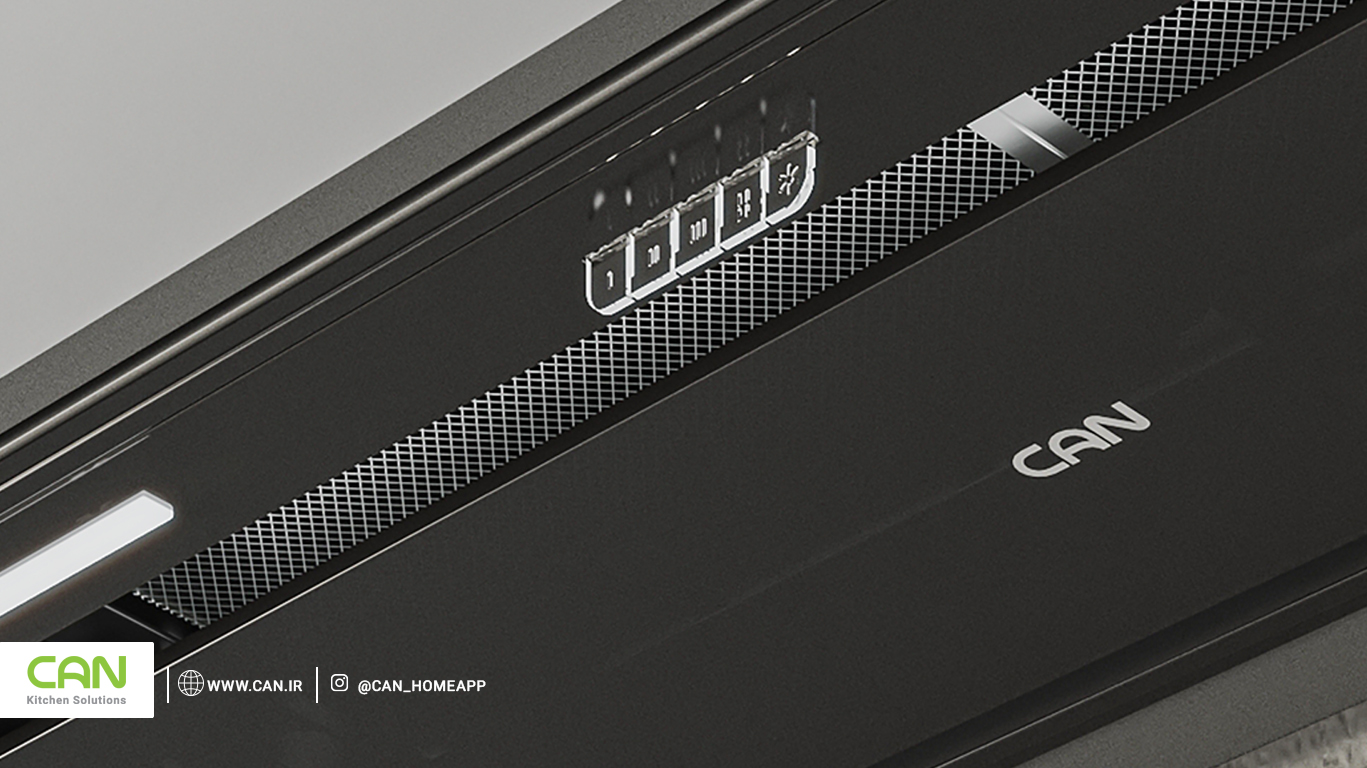
Quick comparison: built-in hood vs. wall hoods (angled and chimney styles)
Wall hoods—like angled or chimney models—can add a luxurious focal point to the kitchen with their bold, elegant design. However, they occupy part of the visual space and may not match a minimalist style. A built-in hood, on the other hand, can deliver the same expected performance while remaining out of sight.
Read more
If you’re undecided between these two options, our specialized article titled Full comparison of built-in vs. wall-mounted hoods is an excellent resource for a deeper, more informed decision.
Built-in hood pros and cons at a glance
A built-in hood, combining a clean look with strong performance, is a popular option—but its installation requires precision, correct placement, and coordination with cabinet space. Here’s a quick summary:
- Pros: Minimal and hidden design, professional and low-noise performance, seamless cabinet harmony, ability to hide lamps/LED lighting.
- Cons: Requires precise installation, needs adequate empty cabinet space, requires coordination between installer and cabinet-maker for proper fit.
Is the suction power of a built-in hood lower?
Not at all. Suction power is determined by the hood’s motor—not its appearance. Can, using metal turbo motors, offers hoods with suction equal to or even stronger than classic wall-mounted models. So, if you choose a built-in hood with a strong, suitable motor from Can—known as the first and largest hood manufacturer in Iran—you won’t notice any drop in suction or performance.
Does a built-in hood produce more noise?
No—often it’s noticeably quieter. Can’s newer hoods use modern technology and acoustic engineering to reduce motor noise (silent design), improving the overall experience. This is one of Can’s key design priorities, keeping noise at a highly acceptable level—even in kitchens without powerful ventilation.
Read more
For a deeper look at Can built-in hoods, we recommend the article Pros and cons of built-in hoods.
Your golden checklist for buying a built-in hood: 7 key points
Suction power
Suction power is the most important factor when choosing a hood, and it depends on your kitchen size and cooking needs. For home kitchens, a suction capacity of about 500 to 700 cubic meters per hour is usually suitable. But if you often use a five-burner cooktop at the same time or cook very greasy foods, we recommend choosing models with 700 m³/h or higher.
Hood size and fit with the cooktop
Standard built-in hood widths include 60, 80, and 90 cm. The hood should be at least equal to—or larger than—the cooktop width so it can properly capture heat and smoke. If your cooktop is larger or more specialized, consider 80 or 90 cm models.
Noise level
A perfectly silent hood doesn’t exist. So when buying a built-in hood, check the noise level (in dB) listed in the manual/spec sheet. Can hoods with silent motors typically produce about 48 to 58 dB—which is subtle enough that, compared to everyday city traffic noise that often reaches the kitchen, you may barely notice it.
Filter type and quality
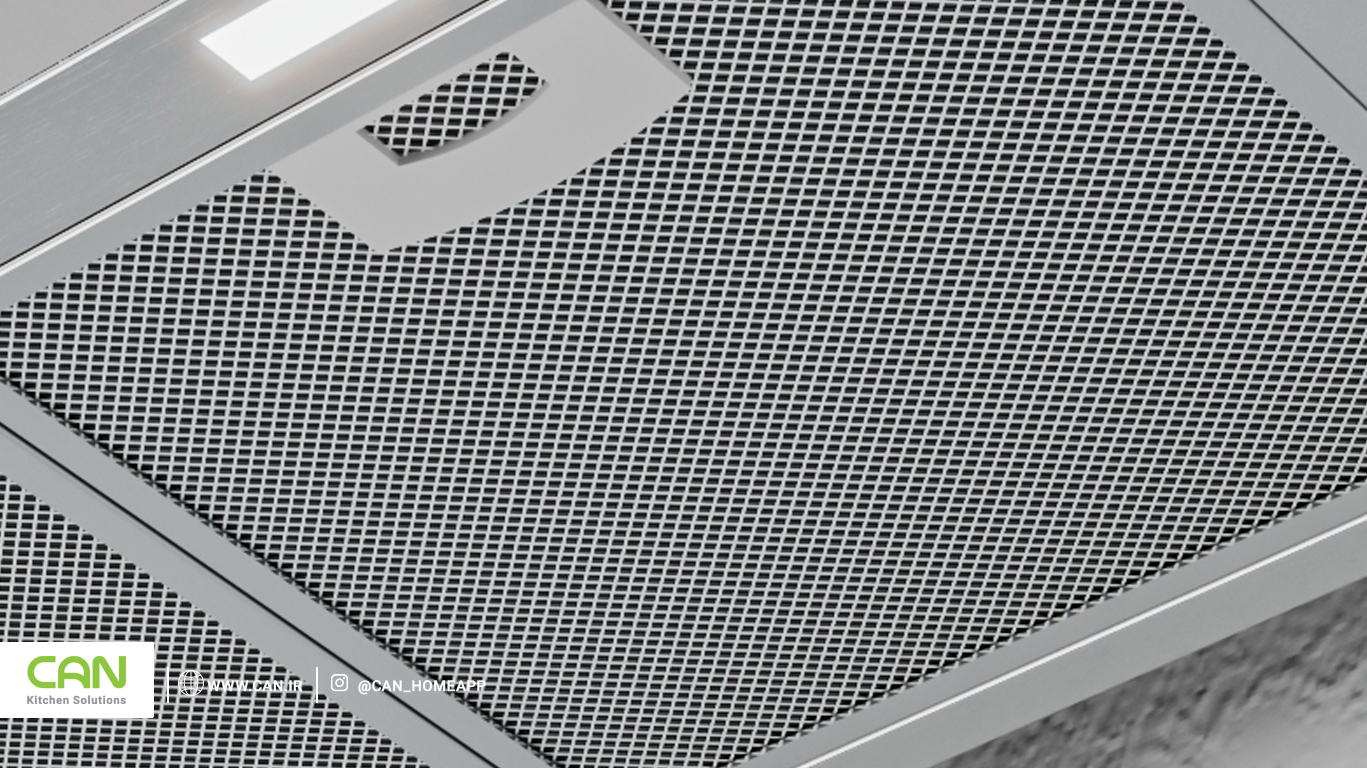
Can hoods have filters that are easy to remove and wash. In addition, some models also support optional charcoal (carbon) filters.
- Washable aluminum filter: Best for kitchens where a ducted air outlet is available.
- Charcoal filter: More suitable for enclosed spaces without an air outlet.
Motor material
One of the standout features of Can hoods is the use of metal turbo motors. These motors deliver stronger suction and higher durability, making them ideal for long-term use.
Extra features
Newer Can hoods come with features such as touch panels, remote control, smoke sensors, heat sensors, low-consumption LED lights, and warm lighting accents for a more attractive kitchen environment—many of these features are also available in built-in models.
Brand and after-sales service
Choosing a product from a reputable brand like Can—with a nationwide service network, official warranty, and readily available spare parts—brings peace of mind. Choosing a Can hood is a smart decision and a reliable investment.
Introducing the best Can built-in hood models in 1405
Hood model Artima +2: simple and powerful
- Size: 70 cm
- Suction power: 700 m³/h
- Turbo motor (plastic/metal)
- Elegant touch panel, low noise (58 to 63 dB), remote control
- Suitable for kitchens where the user needs a strong, straightforward hood.
Hood model Artima 6: advanced tech with complete features
- Size: 80 cm
- Suction power: 700 m³/h
- Die-cast metal turbo motor
- Touch controls, smoke and heat sensors, remote control, timer, adjustable light intensity and color
- Low noise in the 58 to 63 dB range
- One of the most feature-complete under-cabinet hoods produced in Iran, using an RF remote control that works from anywhere in the home.
Hood model 1450: one of Can’s largest built-in hoods
- Sizes: 60 cm and 90 cm
- Suction power: 700 m³/h with a multi-layer washable aluminum filter
- Turbo motor (fire-resistant compound)
- Touch controls, remote control, timer
- Very low noise in the 48 to 58 dB range
- The only Can under-cabinet hood produced and offered in a 90 cm size.
To view detailed specifications and high-quality images of these models, visit the dedicated Can built-in hoods page on the company’s official website and finalize your purchase directly.
Can built-in hoods at a glance
- Suction power: Choose based on kitchen volume and cooking style
- Correct sizing: Hood width should be at least the cooktop length/width
- Low noise: Typically 58 to 63 dB for more comfort
- High-quality filters: Washable, with optional charcoal filters for enclosed spaces
- Metal turbo motor: Long lifespan and strong performance
- Advanced features: Heat/smoke sensors, touch control, timer
- Reliable support: Warranty and nationwide Can service network
For a beautiful, professional, hassle-free kitchen, we strongly recommend a Can built-in hood as the “heart” of the ventilation system. To see real installed built-in hood examples in kitchens, visit Can’s Instagram.
Frequently Asked Questions
- Do we need to remodel the cabinet to install a built-in hood?
Not always. If the cabinet has enough height and depth, installation can be done with the installer’s coordination. Otherwise, a simple adjustment or adding a support base may be needed. - Do we need to replace the filter all the time?
Wash the aluminum filter every 1–2 months with water and detergent. Replace the charcoal filter every 6–8 months. - What is the advantage of a metal motor compared to a plastic one?
A metal motor is more durable, tolerates heat better, and usually needs fewer periodic services—an important point that Can considers in its hood designs. - Is a touch panel better or physical buttons?
Touch panels—used in Can’s modern hoods—offer a more premium feel and more precise control. With proper use, they can be as durable as classic physical buttons. - For homes without an air outlet, which built-in hood is more suitable?
In enclosed environments, choose hoods that support charcoal filters. Can offers this option for some built-in models. - How does Can’s warranty work?
All Can built-in hoods come with an official 2-year warranty, plus 10 years of after-sales service supported by representatives nationwide.
Now, with just one click, you can view the complete Can built-in hood collection and choose your preferred model.

